
Call us now :08045800460
 Send Inquiry
 Send Inquiry
BERNOULL'S THEOREM DEMONSTRATION
BERNOULL'S THEOREM DEMONSTRATION Specification
- Accuracy
- Sufficient for laboratory demonstration - not high precision instrument
- Voltage
- N/A (Not electrically powered)
- Automation Grade
- Manual
- Feature
- Visual demonstration of Bernoullis principle, clear acrylic construction, detachable parts for cleaning
- Capacity
- 1 set (Typical) / Not applicable (demonstration device)
- Temperature Range
- Ambient
- Model No
- Bernoulli Demo 001 or equivalent
- Power Source
- Manual/Gravity-fed (No electrical requirement)
- Frequency
- N/A (Not electrically operated)
- Core Components
- Horizontal tube with varying diameter, manometer tubes, water reservoir, scale, valves
- Measurement Range
- Manometric height differences, pressure and velocity qualitative indication
- Equipment Materials
- Acrylic (tubes), Metal (base, connections), Plastic (reservoir)
- Type
- Educational Lab Equipment
- Usage
- Physics and Fluid Mechanics Laboratory Demonstration
- Display Type
- Glass Tube/Scale Reading
- Dimension (L*W*H)
- Approx. 800 x 200 x 400 mm
- Weight
- Approx. 812 kg
- Tube Material
- Transparent durable acrylic/plastic
- Ideal For
- Undergraduate/School physics and engineering laboratories
- Number of Manometer Tubes
- Generally 56 dependent on model variant
- Demonstration Function
- Visualizes fluid flow, verifies Bernoullis theorem by comparing pressure at various cross sections
- Setup Requirement
- Bench top mounting, simple assembly required
- Water Tank Capacity
- Approx. 510 liters
- Connection Fittings
- Brass/SS for leakage resistance
- Included Accessories
- Flexible hose pipes, instruction manual
- Base Material
- Powder-coated steel for stability and durability
- Flow Control
- Inlet and outlet valves for adjusting water flow
- Portability
- Carry handles for easy transport
About BERNOULL'S THEOREM DEMONSTRATION
Description
For familiarization of energyconversion in divergent/convergent pipe flow, recording the pressure curve in aVenturi nozzle, recording the velocity curve in a Venturi nozzle, fordetermining the flow coefficient and recognizing friction effects Venturisection with transparent front panel. Quick connections are provided foradaptation to feed hydraulics source.
Technical Details
1. 2. 3. 4. Quick releasefitting for easy connection to hydraulics Bench
A comprehensive manual describing how the experimentsare performed and how to commission the equipment will be provided.
Educational software will be as an option
Installation and Training will be provided
The whole set-up is well designed and arranged on arigid structure painted with industrial PU Paint
Experimentation/Learning Objectives
To verify Bernoulli's Theorem experimentally.
To plot the hydraulic gradient line.
To plot the Total energy line Vs distance.
Utilities Required
KCFM-151- Hydraulic Bench.
Clear Visualization of Bernoulli's Principle
This apparatus vividly demonstrates fluid flow through tubes of varying diameters. By adjusting water flow via manual valves, students can observe pressure and velocity changes at different cross sections using scale readings from transparent acrylic manometer tubes.
Durable and User-Friendly Construction
Built with robust powder-coated steel and transparent plastic, the device guarantees long-term usability. Its modular design simplifies assembly and cleaning, while carry handles and compact dimensions make it convenient for classroom use.
Ideal for Laboratory Education
Designed specifically for undergraduate and school laboratories, this demonstration model facilitates real-time learning of fluid mechanics concepts. Instructors can easily showcase Bernoulli's theorem, reinforcing theoretical lessons with practical visualization.
FAQ's of BERNOULL'S THEOREM DEMONSTRATION:
Q: How does the Bernoulli's Theorem Demonstration apparatus work?
A: The device uses water flow through a transparent horizontal tube with varying diameter and manometer tubes to visually show changes in pressure and velocity at different sections, effectively demonstrating Bernoulli's theorem.Q: What measurements does the apparatus display during experiments?
A: It provides qualitative indications of pressure and velocity changes, as observed by manometric height differences in the acrylic tubes. The readings are suited for educational demonstrations rather than high-precision measurements.Q: Where is this equipment typically used?
A: The Bernoulli Demo is ideal for physics and engineering laboratories in schools, colleges, and universities, particularly for undergraduate practical sessions and classroom demonstrations.Q: How is water flow controlled in the demonstration setup?
A: Water flow is manually controlled using inlet and outlet valves, allowing users to adjust the rate and direction of fluid passing through the horizontal test tube during experiments.Q: What are the main benefits of using this apparatus in teaching?
A: It offers a hands-on, visual method for students to understand fluid dynamics concepts, reinforcing Bernoulli's theorem and promoting interactive learning that complements theoretical instruction.Q: Can the demonstration device be easily transported and assembled?
A: Yes, thanks to its carry handles and straightforward bench-top mounting, the apparatus is portable. Assembly is simple and does not require complex tools or electrical power.Q: What materials are used in constructing the apparatus?
A: Key components include transparent acrylic tubes for visibility, a plastic water reservoir, brass or stainless steel fittings for leak resistance, and a powder-coated steel base for durability and stability.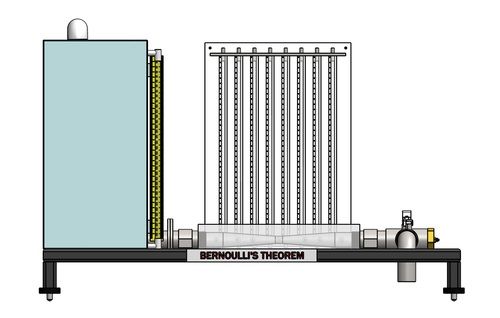
Tell us about your requirement

Price:
Quantity
Select Unit
- 50
- 100
- 200
- 250
- 500
- 1000+
Additional detail
Mobile number
Email

More Products in Fluid Mechanics & Fluid Machinery Category
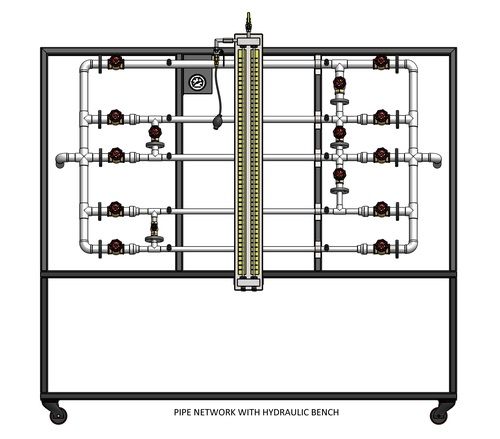
PIPE NETWORK WITH HYDRAULIC BENCH
Usage : Educational/Research Demonstration of Hydraulic Network Principles
Feature : Modular Network, Visible Flow, Quick Release Fittings, Interchangeable Pipe Connections
Measurement Range : 0.2 10 L/min
Frequency : 50 Hz
Equipment Materials : Transparent Acrylic Pipes with Stainless Steel Fittings and Powder Coated Mild Steel Frame
Core Components : Hydraulic Bench, Pipe Network Section, Water Pump, Flow Control Valves, Measuring Tank
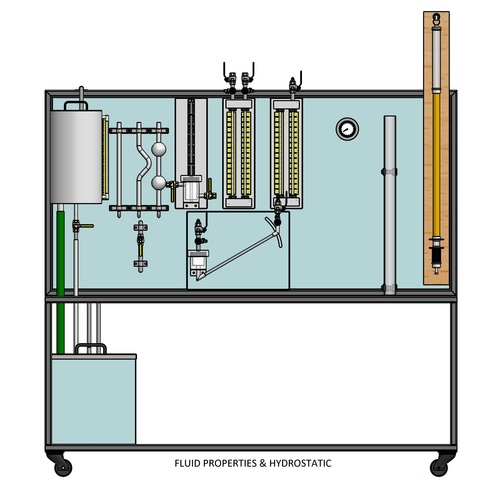
FLUID PROPERTIES AND HYDROSTATIC
Usage : Measurement and demonstration of fluid properties & hydrostatics
Feature : Corrosion resistant, easy to use, robust construction
Measurement Range : 01000 mm (Water Head)
Frequency : 50 Hz
Equipment Materials : Glassware, Metal Stand, Plastic Accessories
Core Components : Glass tube, graduated cylinder, water reservoir, manometer, scale
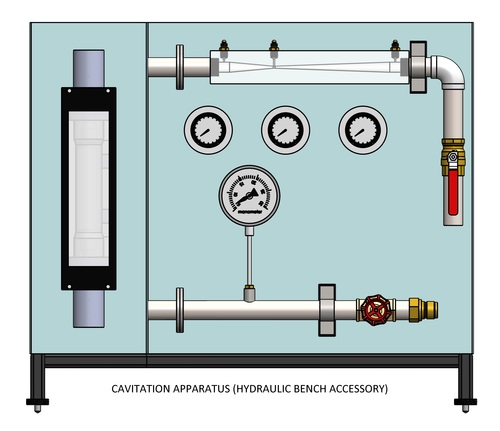
CAVITATION APPARATUS (HYDRAULIC BENCH ACCESSORY)
Usage : For studying Cavitation phenomenon in hydraulics laboratories
Feature : Visual Observation of Cavitation, Easy Mounting on Hydraulic Bench
Measurement Range : Flow measurement up to 4 L/min
Frequency : 50 Hz
Equipment Materials : Stainless Steel, Transparent Acrylic, Powder Coated Mild Steel
Core Components : Scale, Flow Meter, Transparent Cavitation Section, Pressure Gauge
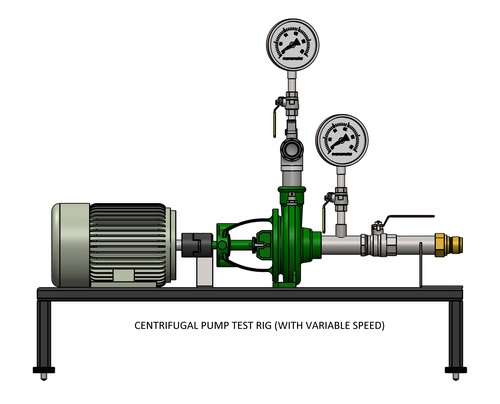
CENTRIFUGAL PUMP TEST RIG (WITH VARIABLE SPEED)
Usage : Lab Testing and Performance Analysis
Feature : Variable Speed Drive, Durable Construction
Measurement Range : 0100 LPM
Frequency : 50 Hz
Equipment Materials : Stainless Steel, Mild Steel Frame
Core Components : Centrifugal Pump, Variable Speed Motor, Control Panel, Flow Meter

 Send Inquiry
Our Products
- Engineering Laboratory Equipments
- Heat Transfer Lab.
- Fluid Mechanics Lab.
- Fluid Machinery Lab.
- Theory Of Machines Lab.
- Refrigeration & Air-conditioning Lab.
- Laboratory Scientific Equipments
- Process Control & Instrumentation Lab.
- Chemical Reaction Engineering Lab.
- Mechanical Operation Lab.
- Mass Transfer Lab.
- Momentum Transfer Lab.
- Enviornmental & Bio-engineering Lab.
- Fluid Mechanics & Fluid Machinery
- Mechanical Engineering Lab


96, HSIDC Industrial Estate, Jagadhari Road, Ambala Cantt - 133001, Haryana, India

Mr Manoj Gupta
(Director)
Mobile :08045800460
 Send Inquiry
 Send SMS
 Call Me Free
Developed and Managed by Infocom Network Private Limited.


