
Call us now :08045800460
 Send Inquiry
 Send Inquiry
PIPE NETWORK WITH HYDRAULIC BENCH
PIPE NETWORK WITH HYDRAULIC BENCH Specification
- Feature
- Modular Network, Visible Flow, Quick Release Fittings, Interchangeable Pipe Connections
- Temperature Range
- Ambient (5C to 40C)
- Core Components
- Hydraulic Bench, Pipe Network Section, Water Pump, Flow Control Valves, Measuring Tank
- Capacity
- 25 Liters
- Voltage
- 220 240 V AC
- Power Source
- Electric (Single Phase)
- Measurement Range
- 0.2 10 L/min
- Automation Grade
- Manual
- Frequency
- 50 Hz
- Model No
- HYD-PN-25
- Accuracy
- 1% of Full Scale
- Equipment Materials
- Transparent Acrylic Pipes with Stainless Steel Fittings and Powder Coated Mild Steel Frame
- Type
- Laboratory Hydraulics Teaching Equipment
- Usage
- Educational/Research Demonstration of Hydraulic Network Principles
- Display Type
- Analog & Digital Flow Meters
- Dimension (L*W*H)
- 1200 mm x 800 mm x 1500 mm
- Weight
- Approx. 45 kg
- Number of Pipe Paths
- 3 Interconnecting Circuits
- Learning Outcomes
- Study of Series and Parallel Pipe Networks, Head Losses, Flow Measurement, Verification of Hydraulic Theories
- Included Accessories
- Instruction Manual, Set of Stopwatches, Measuring Beakers
- Pump Type
- Centrifugal, Self-priming
- Maximum Head
- 2.5 meters
- Manometer
- Mounted Multi-tube Water Manometer for Head Loss Measurement
- Tanks Material
- High Quality PVC/Polycarbonate
- Safety
- Overload Protection for Pump, Non-slip Base
- Connections
- Quick Release Couplings
- Pipe Diameter
- 12 mm, 16 mm, 20 mm (different sizes for network analysis)
About PIPE NETWORK WITH HYDRAULIC BENCH
Description
To determinePressure losses at various piping elements and pipe networks; parallel andseries connection of pipe sections, combined series and parallel connection.
1. 2. 3. 4. 5. 6. 7. 8. 9. 9.1.9.2.9.3.9.4.9.5.9.6.Self-priming centrifugal circulatingpump a maximum flow greater than 60L/min
Technical Details
Pipe network, max. Flow rate: 4.8cumec
Pipe sections, length 700 mm each; 1x:25 x 1.9 mm, 2 x:20 x 1.5mm and 2x:16x 1.2mm
Twin tube manometers: Stopwatch:1/100s
Measuring ranges; differentialpressure:1x 0 to 1bar and differential pressure with tube manometers;2x 0 to100 mbar
A comprehensive manual describing howthe experiment are performed and how to commission the equipment will beprovided.
Educational software will be as anoption
Installation and Training will beprovided.
The whole set-up is well designed andarranged on a rigid structure painted with industrial PU Paint.
Utilities Required
KCFM-151..... Hydraulic Bench.
Versatile Network Analysis
This equipment's modular system enables the demonstration of complex hydraulic networks using three interconnecting pipe circuits of various diameters. Easily switch between series and parallel configurations to observe and compare network behavior.
Accurate Measurement Tools
The mounted multi-tube water manometer, together with analog and digital flow meters, offers precise head loss and flow measurements. With an accuracy of 1% of full scale, students can verify hydraulic principles with confidence.
Safety and Durability Assured
Built with transparent acrylic pipes, stainless steel fittings, and a powder-coated steel frame, the unit prioritizes robustness. Overload protection for the pump and a non-slip base enhance operational safety during demonstration and hands-on experiments.
Ideal for Educational Settings
Designed for academic and research use, this hydraulic bench comes with a thorough instruction manual, stopwatches, and measuring beakers. Its visible flow paths and quick release couplings make learning interactive, while the manual setup develops practical skills in hydraulic studies.
FAQ's of PIPE NETWORK WITH HYDRAULIC BENCH:
Q: How does the hydraulic bench help in understanding pipe network principles?
A: The hydraulic bench demonstrates both series and parallel network configurations using three interconnected pipes of varying diameters. It enables hands-on exploration of head losses, flow rates, and hydraulic principles, making theoretical concepts tangible for students and researchers.Q: What is the process for measuring head loss and flow in the pipe circuits?
A: Head loss is measured using the mounted multi-tube water manometer, while flow is tracked via integrated analog and digital flow meters. By adjusting flow control valves and using the quick release couplings, users can configure the pipe network and accurately monitor changes in system behavior.Q: When should this equipment be used in a learning environment?
A: This apparatus is ideal for laboratory sessions focused on fluid mechanics, particularly during modules on hydraulic networks, flow measurement, and system analysis. It enhances understanding during both introductory and advanced lessons or research projects involving hydraulic principles.Q: Where is the PIPE NETWORK WITH HYDRAULIC BENCH typically utilized?
A: The equipment is used in universities, technical colleges, and research institutes across India and internationally. Its design facilitates both classroom demonstrations and experimental research in educational laboratories.Q: What are the major benefits of using this hydraulic network equipment?
A: Major benefits include the modular and visible setup for interactive learning, the ability to study real-time flow and head loss, and robust safety features. It encourages accurate experimental analysis and supports hands-on verification of hydraulic theories.Q: How can the pipe network be reconfigured for different experiments?
A: The system uses interchangeable pipe sections with quick release couplings, allowing users to easily switch between different pipe diameters and network configurations. Simple adjustments to the network facilitate diverse experiments on flow distribution and loss measurement.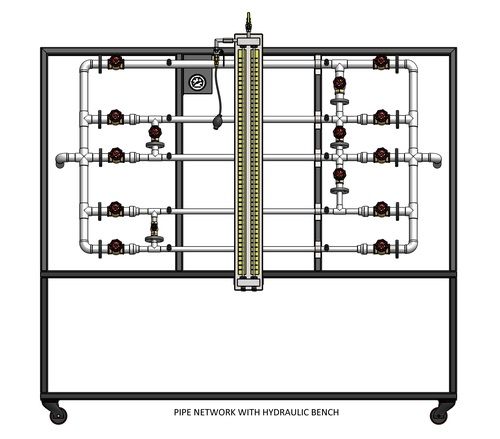
Tell us about your requirement

Price:
Quantity
Select Unit
- 50
- 100
- 200
- 250
- 500
- 1000+
Additional detail
Mobile number
Email

More Products in Fluid Mechanics & Fluid Machinery Category
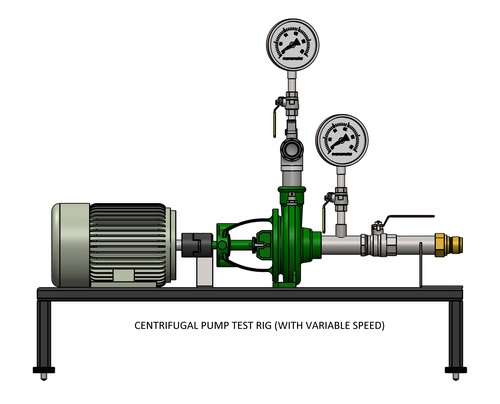
CENTRIFUGAL PUMP TEST RIG (WITH VARIABLE SPEED)
Usage : Lab Testing and Performance Analysis
Feature : Variable Speed Drive, Durable Construction
Automation Grade : SemiAutomatic
Frequency : 50 Hz
Model No : CPTRVS01
Accuracy : 1%
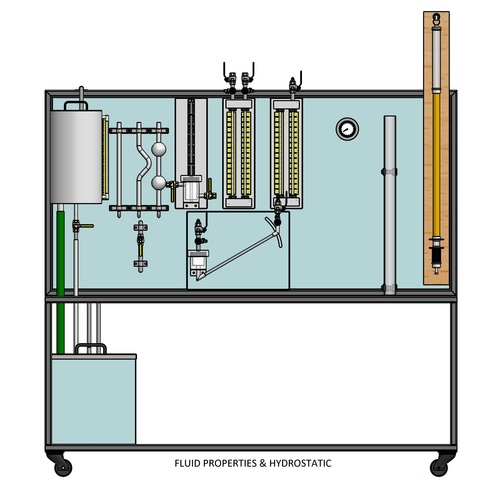
FLUID PROPERTIES AND HYDROSTATIC
Usage : Measurement and demonstration of fluid properties & hydrostatics
Feature : Corrosion resistant, easy to use, robust construction
Automation Grade : Manual
Frequency : 50 Hz
Model No : FPM101
Accuracy : 1 mm
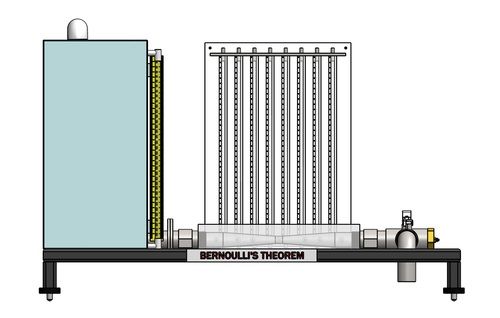
BERNOULL'S THEOREM DEMONSTRATION
Usage : Physics and Fluid Mechanics Laboratory Demonstration
Feature : Visual demonstration of Bernoullis principle, clear acrylic construction, detachable parts for cleaning
Automation Grade : Manual
Frequency : N/A (Not electrically operated)
Model No : Bernoulli Demo 001 or equivalent
Accuracy : Sufficient for laboratory demonstration not high precision instrument
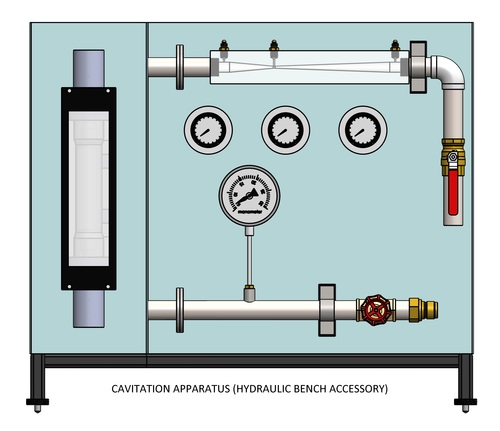
CAVITATION APPARATUS (HYDRAULIC BENCH ACCESSORY)
Usage : For studying Cavitation phenomenon in hydraulics laboratories
Feature : Visual Observation of Cavitation, Easy Mounting on Hydraulic Bench
Automation Grade : Manual
Frequency : 50 Hz
Model No : CAVI05
Accuracy : 1% for manometric measurements

 Send Inquiry
Our Products
- Engineering Laboratory Equipments
- Heat Transfer Lab.
- Fluid Mechanics Lab.
- Fluid Machinery Lab.
- Theory Of Machines Lab.
- Refrigeration & Air-conditioning Lab.
- Laboratory Scientific Equipments
- Process Control & Instrumentation Lab.
- Chemical Reaction Engineering Lab.
- Mechanical Operation Lab.
- Mass Transfer Lab.
- Momentum Transfer Lab.
- Enviornmental & Bio-engineering Lab.
- Fluid Mechanics & Fluid Machinery
- Mechanical Engineering Lab


96, HSIDC Industrial Estate, Jagadhari Road, Ambala Cantt - 133001, Haryana, India

Mr Manoj Gupta
(Director)
Mobile :08045800460
 Send Inquiry
 Send SMS
Developed and Managed by Infocom Network Private Limited.


