
Call us now :08045800460
 Send Inquiry
 Send Inquiry
FLUID PROPERTIES AND HYDROSTATIC
FLUID PROPERTIES AND HYDROSTATIC Specification
- Accuracy
- 1 mm
- Power Source
- Manual
- Measurement Range
- 0-1000 mm (Water Head)
- Temperature Range
- Ambient
- Voltage
- 230 V
- Frequency
- 50 Hz
- Feature
- Corrosion resistant, easy to use, robust construction
- Core Components
- Glass tube, graduated cylinder, water reservoir, manometer, scale
- Automation Grade
- Manual
- Capacity
- 2 Liters
- Model No
- FPM-101
- Equipment Materials
- Glassware, Metal Stand, Plastic Accessories
- Type
- Educational Laboratory Equipment
- Usage
- Measurement and demonstration of fluid properties & hydrostatics
- Display Type
- Analog
- Dimension (L*W*H)
- 450 mm x 300 mm x 400 mm
- Weight
- 5 kg (approx)
- Packaging Type
- Box
- Mounting
- Tabletop
- Application
- Fluid mechanics lab, hydrostatics demonstration
- Test Fluids Compatible
- Water, safe laboratory fluids
- Design Standard
- Conforms to laboratory safety and educational standards
- Color
- Transparent with metal fittings
About FLUID PROPERTIES AND HYDROSTATIC
Description
Aself- contained and mobile unit for demonstration of the properties of fluidsand hydrostatics for basic experiments in hydrostatics
Widerange of experiments with (Fluid properties)
Closedwater circuit with tank and pump.
Thebench top incorporates a recessed sinks.
Componentswill be stored on support frame
Experimentation/Learning Objectives
To study the operation of :
Universal hydrometer and hydrometer jar
Falling sphere viscometer
Free surface tube
Bourdon gauge
U-tube manometer
Hydrostatic pressure
Capillary tube apparatus
Technical Details
1. 2. 3. 4. 5. 6. 7. 8. 9. 10.
11. 12. 12.1 12.2 12.3 12.4 13. 13.1 13.2
13.3
13.4
14. 15. 15.1 15.2 15.3 15.4 15.5 16.
A comprehensive manual describing how the experimentsare performed and how to commission the equipment will be provided.
Educational software will be provided as an option.
Installation and training will be provided.
The whole set-up is well designed and arranged on arigid structure painted with industrial PU Paint.
Versatile Laboratory Demonstrator
This apparatus is ideal for fluid mechanics and hydrostatics teaching. Its tabletop mounting and manual operation enable hands-on learning. The graduated cylinder and analog display facilitate accurate readings while the corrosion-resistant materials ensure durability.
Safe and Transparent Design
Crafted from laboratory-grade glassware and fitted with metals and plastics, the equipment is transparent, providing clear visual demonstrations. Safety is ensured by adhering to educational standards, making it suitable for students and researchers.
FAQ's of FLUID PROPERTIES AND HYDROSTATIC:
Q: How is the FLUID PROPERTIES AND HYDROSTATIC FPM-101 used in a fluid mechanics laboratory?
A: The equipment is typically used to measure and demonstrate various fluid properties, including hydrostatic pressure, by observing water levels and pressure changes within its graduated components. Experiments involve adding or removing water and monitoring readings on the analog scale.Q: What fluids can be safely tested with this device?
A: The FPM-101 is compatible with water and other safe laboratory fluids. It is constructed from corrosion-resistant materials, ensuring safe use with standard educational liquids.Q: When should this apparatus be deployed during laboratory sessions?
A: This device is best utilized during foundational experiments on fluid properties and hydrostatics, often at the start of laboratory modules. Its straightforward manual operation supports instructional demonstrations and student experiments.Q: Where can the equipment be mounted and operated?
A: Designed for tabletop mounting, the apparatus is compact and stable, allowing use in classroom labs, research spaces, or training workshops. Its box packaging makes it easy to store and transport.Q: What is the process for measuring hydrostatic pressure with the FPM-101?
A: Users pour a measured volume of water into the reservoir and observe fluid levels through the transparent components. Using the analog scale and manometer, changes in hydrostatic pressure are read off directly, with precision up to 1 mm.Q: What benefits does the FPM-101 offer for educational demonstrations?
A: By providing clear visualizations and precise analog measurements, the equipment helps students grasp fundamental fluid dynamics concepts. Its robust, corrosion-resistant build ensures long-term reliability and ease of use in teaching environments.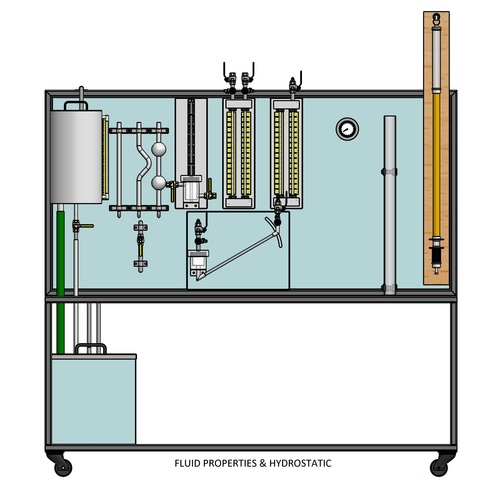
Tell us about your requirement

Price:
Quantity
Select Unit
- 50
- 100
- 200
- 250
- 500
- 1000+
Additional detail
Mobile number
Email

More Products in Fluid Mechanics & Fluid Machinery Category
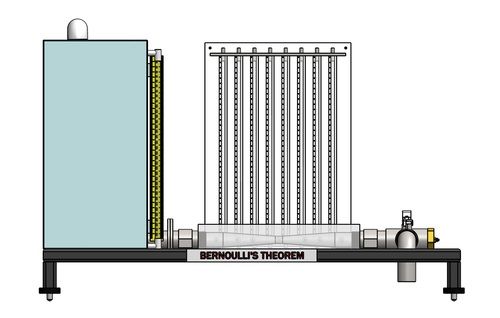
BERNOULL'S THEOREM DEMONSTRATION
Feature : Visual demonstration of Bernoullis principle, clear acrylic construction, detachable parts for cleaning
Usage : Physics and Fluid Mechanics Laboratory Demonstration
Voltage : N/A (Not electrically powered)
Frequency : N/A (Not electrically operated)
Measurement Range : Manometric height differences, pressure and velocity qualitative indication
Power Source : Manual/Gravityfed (No electrical requirement)
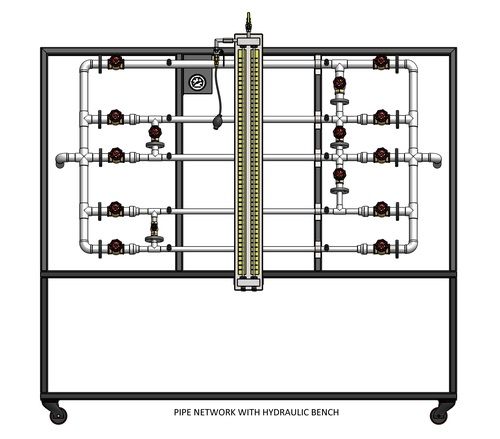
PIPE NETWORK WITH HYDRAULIC BENCH
Feature : Modular Network, Visible Flow, Quick Release Fittings, Interchangeable Pipe Connections
Usage : Educational/Research Demonstration of Hydraulic Network Principles
Voltage : 220 240 V AC
Frequency : 50 Hz
Measurement Range : 0.2 10 L/min
Power Source : Electric (Single Phase)
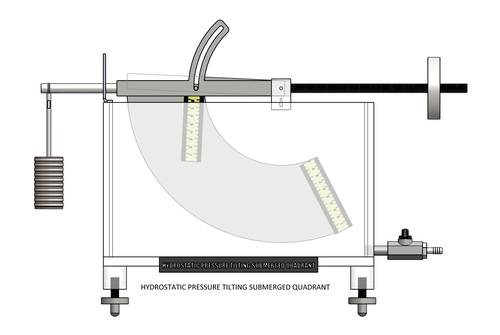
HYDROSTATIC PRESSURE TILTING SUBMERGED QUADRANT
Feature : Enables direct observation and measurement of hydrostatic forces with variable angle adjustment
Usage : Physics and fluid mechanics laboratory experiments
Voltage : Not required / Not applicable
Frequency : N/A (Nonelectrical)
Measurement Range : Up to the full submersion of the quadrant body, depending on tank size
Power Source : Manual, nonelectric
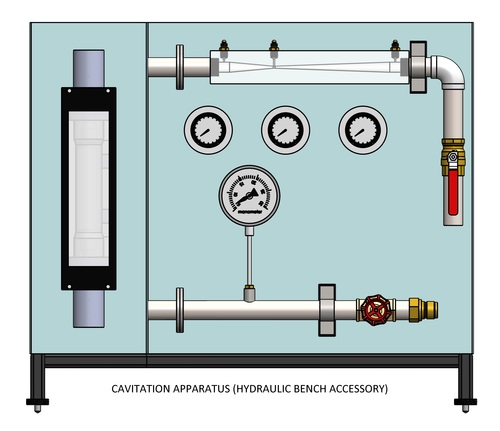
CAVITATION APPARATUS (HYDRAULIC BENCH ACCESSORY)
Feature : Visual Observation of Cavitation, Easy Mounting on Hydraulic Bench
Usage : For studying Cavitation phenomenon in hydraulics laboratories
Voltage : 230V AC (via hydraulic bench)
Frequency : 50 Hz
Measurement Range : Flow measurement up to 4 L/min
Power Source : Hydraulic Bench Supply

 Send Inquiry
Our Products
- Engineering Laboratory Equipments
- Heat Transfer Lab.
- Fluid Mechanics Lab.
- Fluid Machinery Lab.
- Theory Of Machines Lab.
- Refrigeration & Air-conditioning Lab.
- Laboratory Scientific Equipments
- Process Control & Instrumentation Lab.
- Chemical Reaction Engineering Lab.
- Mechanical Operation Lab.
- Mass Transfer Lab.
- Momentum Transfer Lab.
- Enviornmental & Bio-engineering Lab.
- Fluid Mechanics & Fluid Machinery
- Mechanical Engineering Lab


96, HSIDC Industrial Estate, Jagadhari Road, Ambala Cantt - 133001, Haryana, India

Mr Manoj Gupta
(Director)
Mobile :08045800460
 Send Inquiry
 Send SMS
Developed and Managed by Infocom Network Private Limited.


